
Managing proxy rotation effectively separates successful web scraping operations from those plagued by constant IP bans and failed requests. Modern web application firewalls detect improper rotation patterns within milliseconds, causing scraping projects to collapse before gathering meaningful data. This comprehensive guide walks you through preparation, execution, and verification of proxy rotation strategies optimized for mobile IPs, enabling you to maintain uninterrupted SEO monitoring, social media management, and ad verification workflows in 2026. You'll learn how to choose the right infrastructure, implement rotation algorithms that evade detection, and troubleshoot common issues that derail automation projects.
Table of Contents
- Understanding Proxy Rotation Challenges And Choosing The Right Ip Type
- Preparing Your Proxy Rotation System: Infrastructure And Session Management
- Executing Step-By-Step Proxy Rotation: Algorithms And Best Practices
- Verifying Success And Troubleshooting Common Proxy Rotation Issues
- Explore High-Quality Mobile Proxies And Tools At Proxy Poland
- What Is Proxy Rotation And Why Is It Necessary?
- How Do Mobile Ip Proxies Improve Proxy Rotation Success?
- What Are The Best Practices For Setting Proxy Rotation Frequency?
- How Can I Avoid Session Correlation When Rotating Proxies?
Key takeaways
| Point | Details |
|---|---|
| Rotation timing matters | Rotating proxies too fast triggers new visitor detection while rotating too slowly causes rate limiting and blocks. |
| Mobile IPs resist bans | Mobile proxies leverage carrier-grade NAT making permanent blacklisting unlikely since blocking affects thousands of legitimate users. |
| Sticky sessions boost success | Maintaining connection persistence for 30-45 minutes increases scraping success rates compared to constant IP switching. |
| Geographic consistency prevents flags | Mismatched IP locations and inconsistent browser fingerprints create suspicious patterns that trigger session correlation. |
| Infrastructure preparation is critical | Proper setup of rotation algorithms and session management prevents detection before execution begins. |
Understanding proxy rotation challenges and choosing the right IP type
Modern web security systems have evolved far beyond simple IP blocking. Executing concurrent HTTP requests from a singular IP address guarantees operational failure within milliseconds due to deep packet inspection and behavioral analysis performed by web application firewalls. These systems track request patterns, timing intervals, and connection fingerprints to identify automated traffic.
Datacenter proxies face the highest detection rates because their IP addresses belong to known hosting providers with easily identifiable autonomous system numbers. Security systems maintain constantly updated blacklists of datacenter ranges, flagging requests immediately upon connection. Even rotating datacenter IPs rapidly provides minimal protection since the underlying infrastructure signatures remain consistent.
Residential proxies offer moderate improvement by using IP addresses assigned to actual households. However, residential proxy networks face reputational scoring systems that track abuse patterns across shared IP pools. When multiple users route traffic through the same residential IP, the cumulative request volume creates detection signals that affect all users sharing that address.
Mobile IPs are effectively immune to permanent blacklisting due to carrier-grade network address translation forcing websites to risk blocking thousands of legitimate mobile users when blacklisting a single IP. Mobile carriers rotate IP addresses across their entire subscriber base, making it nearly impossible for websites to maintain effective blocklists without sacrificing mobile accessibility.
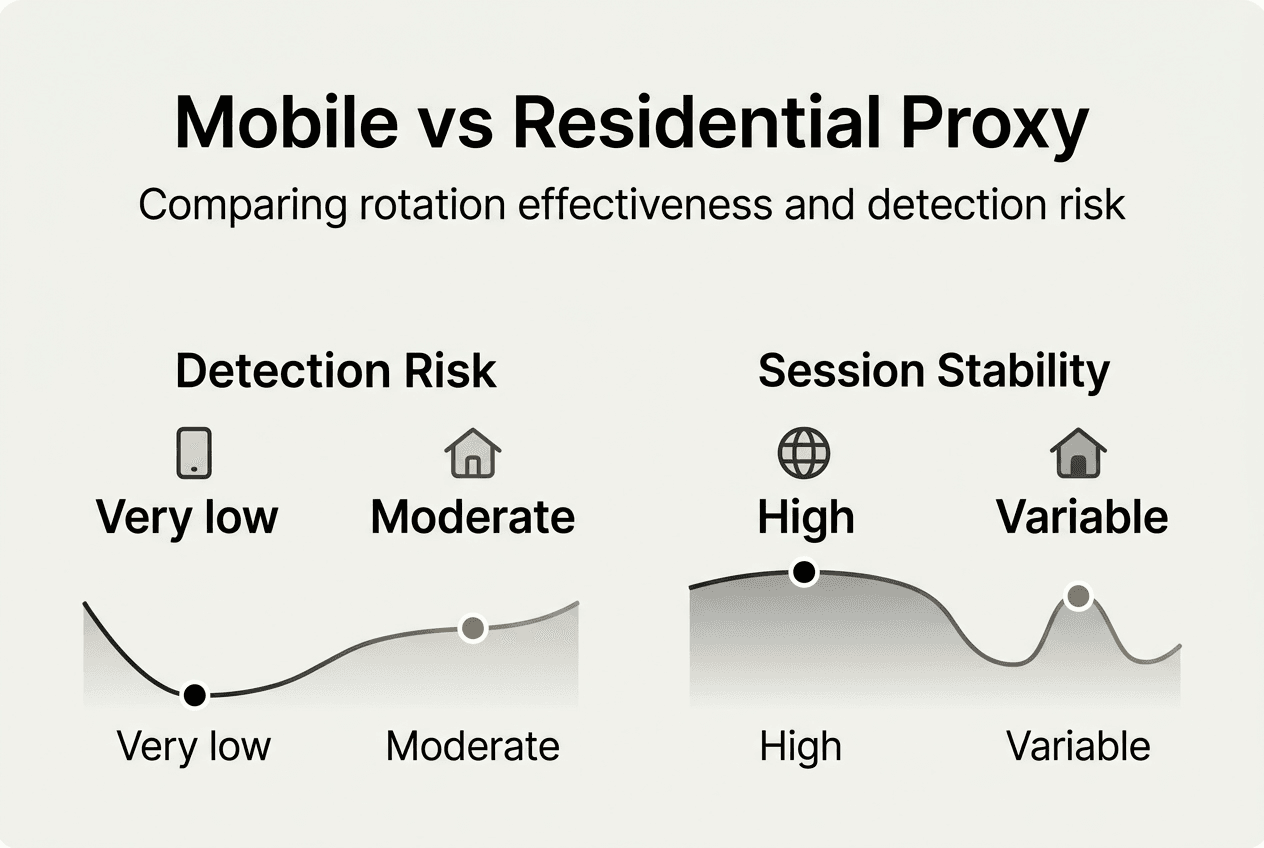
Comparing mobile vs residential proxies reveals critical differences in detection resistance and session stability. Mobile IPs provide superior trust scores on platforms that scrutinize proxy traffic because they originate from authentic carrier networks using physical SIM cards and modems. The infrastructure backing mobile proxies creates digital signatures indistinguishable from genuine smartphone users.
Pro Tip: When evaluating proxy types, prioritize infrastructure authenticity over price. The cost of failed scraping operations and permanent account bans far exceeds the premium paid for genuine mobile IP addresses operating on real carrier networks.
Proxy type comparison for rotation success:
| Proxy Type | Detection Risk | Rotation Effectiveness | Best Use Case |
|---|---|---|---|
| Datacenter | Very High | Poor | Low-stakes testing |
| Residential | Moderate | Good | General web scraping |
| Mobile IP | Very Low | Excellent | Platform automation, social media |
The choice between datacenter vs mobile proxies fundamentally determines rotation strategy success. Mobile IPs support longer session durations and higher request volumes per IP before triggering rate limits, reducing the frequency of required rotations and simplifying infrastructure management.
Preparing your proxy rotation system: infrastructure and session management
Successful proxy rotation begins long before executing your first request. Infrastructure preparation determines whether your rotation strategy maintains session continuity or creates detection patterns that expose automated traffic. Start by configuring your proxy pool to support sticky sessions, which maintain the same IP address for a defined duration rather than switching on every request.

Sticky sessions enable logged-in scraping sessions lasting up to 45 minutes versus the fragmented sessions created by aggressive rotation. Platforms tracking user behavior across multiple requests flag accounts that appear to teleport between geographic locations or exhibit impossible connection patterns. Sticky sessions preserve the illusion of a single user browsing from one location.
Geographic consistency forms another critical preparation element. Align your proxy IP locations with the geographic targeting of your target websites. A user appearing to browse from Poland should maintain Polish IP addresses throughout their session rather than jumping between countries. Inconsistent geographic IP locations and browser fingerprinting lead to session correlation and immediate flagging by security systems.
Browser fingerprint consistency requires matching user-agent strings, screen resolutions, installed fonts, and canvas fingerprints to the expected profile of your proxy IP location. A mobile IP from Poland combined with a user-agent string claiming to be a desktop browser in California creates obvious inconsistencies. Use browser fingerprint testing tools to verify that your automation presents coherent digital identities.
Rotation frequency planning prevents both over-rotation and under-rotation failures. Calculate optimal rotation intervals based on your target website's rate limiting thresholds and typical user session durations. The proxy rotation calculator helps determine ideal timing by analyzing request volumes and session requirements.
Pro Tip: Document your target platform's typical user behavior patterns before implementing rotation. Mimicking real user session lengths and request intervals makes your automation invisible to behavioral analysis systems.
Essential preparation checklist:
- Configure sticky session support in your proxy infrastructure
- Verify geographic alignment between proxy IPs and target platforms
- Generate consistent browser fingerprints matching proxy locations
- Calculate rotation intervals based on platform rate limits
- Test proxy pool health before production deployment
- Establish monitoring systems for ban detection and success tracking
Executing step-by-step proxy rotation: algorithms and best practices
Implementing effective proxy rotation requires moving beyond random IP selection to probabilistic algorithms that distribute load intelligently across your proxy pool. Random rotation creates clustering patterns where some proxies receive disproportionate traffic while others remain underutilized, increasing detection risk on overused IPs.
Start by implementing a weighted round-robin algorithm that tracks request counts per proxy and prioritizes underutilized IPs. This approach ensures even distribution while maintaining the unpredictability needed to avoid pattern detection. Track success rates for each proxy and adjust weights dynamically to favor high-performing IPs.
Sticky session implementation forms the foundation of successful rotation. Configure your system to maintain the same IP address for a minimum session duration rather than rotating on every request. Rotating proxies too aggressively triggers new visitor detection while rotating too slowly triggers rate limits, requiring careful balance.
Step-by-step rotation implementation:
- Initialize your proxy pool with health-checked, verified IP addresses
- Assign initial proxies using weighted selection favoring unused IPs
- Maintain sticky sessions for 20-45 minutes depending on platform requirements
- Monitor request success rates and response times per proxy
- Rotate to fresh IPs when session duration expires or errors occur
- Update proxy weights based on performance metrics and ban detection
- Remove failed proxies from rotation pool immediately
Error handling determines rotation system resilience. When a proxy fails, implement exponential backoff before retry attempts rather than immediately switching to another IP. Rapid switching after failures creates suspicious traffic patterns. If a proxy consistently fails, remove it from your pool entirely to prevent session poisoning.
Pro Tip: Implement a cooling-off period for proxies that receive rate limiting responses. Temporarily removing them from rotation for 15-30 minutes often resolves soft bans without requiring permanent removal.
Rotation interval recommendations:
| Use Case | Optimal Interval | Session Duration | Requests per IP |
|---|---|---|---|
| Social media automation | 30-45 minutes | Sticky | 200-500 |
| E-commerce scraping | 15-20 minutes | Sticky | 100-300 |
| Ad verification | 20-30 minutes | Sticky | 150-400 |
| SEO monitoring | 25-40 minutes | Sticky | 300-600 |
Monitor rotation performance continuously rather than setting static intervals. Platforms adjust their security measures regularly, requiring adaptive rotation strategies. Track metrics including request success rates, average response times, and ban frequencies to identify when rotation parameters need adjustment.
Implement request pacing within each sticky session to mimic human browsing patterns. Spacing requests 2-5 seconds apart with random variation prevents the mechanical timing patterns that expose automation. Combine pacing with realistic navigation flows that include expected page views and interaction sequences.
The large-scale proxy rotation guide provides advanced strategies for managing hundreds or thousands of concurrent sessions. Scaling rotation systems requires distributed architecture and sophisticated state management to maintain session consistency across multiple workers.
For specialized scraping workflows, consult the mobile proxy web scraping setup guide covering framework integration and protocol optimization. Proper configuration of scraping tools to leverage mobile IP advantages maximizes success rates.
Verifying success and troubleshooting common proxy rotation issues
Continuous monitoring separates reliable rotation systems from those that fail silently until critical operations collapse. Establish comprehensive logging that tracks request outcomes, response codes, and timing metrics for every proxy in your pool. Success verification requires analyzing patterns rather than individual request results.
Calculate ban rates by tracking the percentage of requests receiving CAPTCHA challenges, 403 errors, or connection timeouts. Ban rates exceeding 5% indicate rotation strategy failures requiring immediate adjustment. Monitor these metrics per proxy and across your entire pool to identify whether issues stem from specific IPs or systemic configuration problems.
Proxy validation before production use prevents burned IPs from poisoning your sessions. Using burned or banned IPs poisons entire sessions and leads to permanent blocks affecting your entire operation. Test new proxies against your target platforms using low-risk requests before adding them to production rotation pools.
The proxy tester tools validate IP addresses by checking anonymity levels, geographic accuracy, and connection speeds. Run these tests on a schedule to catch degraded proxies before they impact production workflows. Automated testing catches issues that manual monitoring misses.
Pro Tip: Set up alert thresholds that notify you when ban rates spike or success rates drop below acceptable levels. Early detection enables rapid response before cascading failures compromise your entire operation.
Common rotation failures and solutions:
- Rapid session termination: Increase sticky session duration and reduce request frequency per IP
- Geographic inconsistency flags: Verify IP geolocation matches user-agent and language headers
- Fingerprint mismatches: Regenerate browser profiles to match proxy IP characteristics
- Rate limiting despite rotation: Implement longer cooling periods between proxy reuse cycles
- CAPTCHA challenges: Reduce request velocity and improve request header authenticity
- Connection timeouts: Test proxy connectivity and replace unreliable IPs
Log analysis reveals patterns invisible in real-time monitoring. Review logs weekly to identify subtle detection signals like gradually increasing response times or growing CAPTCHA rates. These early warning signs allow proactive adjustment before hard bans occur.
"The difference between successful and failed proxy rotation often lies in monitoring granularity. Track not just whether requests succeed, but how success rates trend over time and across different proxies."
Troubleshooting requires systematic isolation of variables. When experiencing elevated ban rates, test individual components separately: verify proxy health, validate fingerprint consistency, confirm geographic alignment, and check rotation timing. This methodical approach identifies root causes rather than treating symptoms.
Maintain a rotation performance baseline during known-good operational periods. Compare current metrics against this baseline to quantify degradation severity and prioritize troubleshooting efforts. Significant deviations from baseline performance indicate configuration drift or platform security changes requiring strategy updates.
Explore high-quality mobile proxies and tools at Proxy Poland
Implementing the rotation strategies outlined in this guide requires infrastructure built on authentic mobile IP addresses that resist detection and support extended sticky sessions. Proxy Poland operates dedicated 4G and 5G mobile proxies using physical modems and SIM cards on the Polish carrier network, providing IP addresses indistinguishable from genuine mobile users.

The platform delivers instant setup within 10 seconds and supports 2-second IP rotation when needed, combined with sticky session capabilities for maintaining consistent connections during critical automation workflows. Dedicated bandwidth of 30-100 Mbps ensures your scraping operations never compete with other users, while the strict one-user-per-proxy policy eliminates the shared IP risks that plague residential proxy networks. Access 4G mobile proxies Poland to explore plans optimized for SEO monitoring, social media automation, and ad verification.
Plan your rotation strategy using the proxy rotation calculator to determine optimal IP cycling intervals based on your request volumes and target platform requirements. Validate proxy health and performance with the built-in proxy tester tools before deploying them in production environments. These resources transform rotation theory into practical implementation, helping you maintain uninterrupted operations across platforms that aggressively detect and block automated traffic.
What is proxy rotation and why is it necessary?
Proxy rotation involves systematically cycling through different IP addresses when making web requests to distribute traffic across multiple endpoints and avoid detection. Modern websites track request patterns from individual IPs, flagging accounts that exceed normal usage thresholds or exhibit automated behavior signatures. Rotation prevents any single IP from accumulating suspicious request volumes that trigger rate limiting or permanent bans. It is necessary to maintain uninterrupted scraping, automation, and ad verification operations across platforms deploying sophisticated anti-bot systems that block static IP addresses within minutes.
How do mobile IP proxies improve proxy rotation success?
Mobile IP proxies use authentic addresses from cellular carrier networks, making them significantly harder to block than datacenter or residential alternatives. Mobile IPs are effectively immune to permanent blacklisting due to carrier-grade NAT forcing sites to risk blocking thousands of legitimate users when targeting a single IP address. They support longer sticky sessions resulting in higher scraping success rates because platforms trust mobile traffic more than requests from known proxy infrastructure. The carrier-grade infrastructure behind mobile IPs creates digital signatures matching genuine smartphone users, evading the behavioral analysis systems that detect other proxy types.
What are the best practices for setting proxy rotation frequency?
Rotate proxies at intervals balancing detection avoidance with session continuity, typically maintaining sticky sessions for 20-45 minutes depending on platform requirements. Rotating proxies too aggressively triggers new visitor detection while rotating too slowly causes rate limiting as request volumes accumulate on individual IPs. Use the proxy rotation calculator to determine optimal timing based on your specific request volumes and target platform rate limits. Monitor success rates continuously and adjust intervals dynamically when detecting increased CAPTCHA challenges or elevated error rates.
How can I avoid session correlation when rotating proxies?
Maintain consistent browser fingerprints and ensure IP geographic locations align with all session activity to prevent correlation detection. Consistent browser fingerprints and IP location jumps create suspicious flags leading to session correlation when security systems detect impossible geographic transitions or mismatched device characteristics. Use fingerprint testing tools to verify that user-agent strings, screen resolutions, and canvas fingerprints match the expected profile of your proxy IP location. Implement sticky sessions that maintain the same IP throughout logical user workflows rather than switching mid-session, and ensure all request headers present coherent digital identities that match genuine user patterns from your proxy's geographic region.